
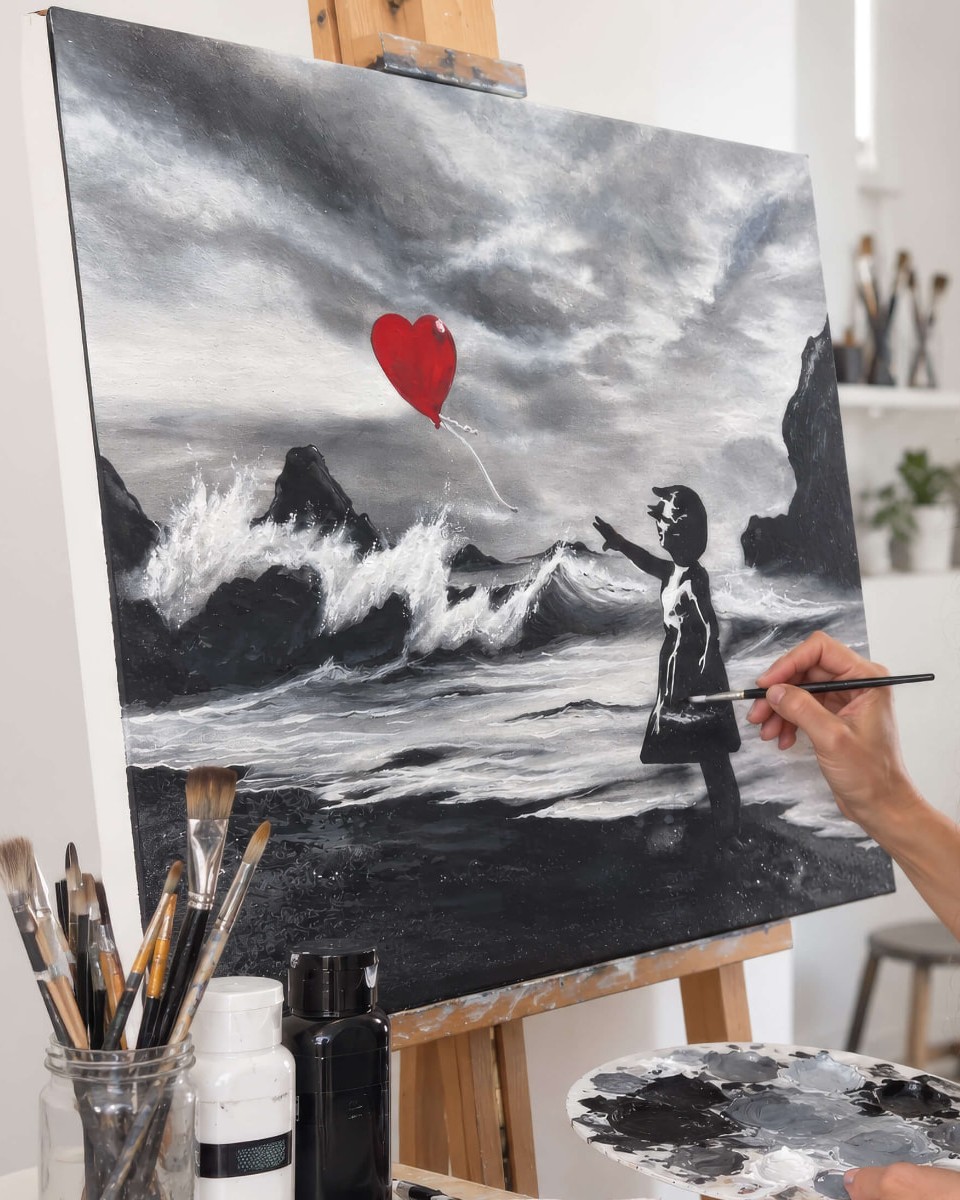
Artist Tamara Bolger kept a small red notebook while painting a memorial piece for a young woman she never met. These are her words.
In the summer of 2026, a family asked Tamara Bolger to paint a memorial piece for their daughter, with a small amount of her cremated remains worked into the finished canvas. Tamara never met her. When the painting was complete, Tamara sent the parents the notebook she had kept throughout, along with a letter. The family has allowed us to share it; their names stay private, and Tamara's entries are shortened.
“I don't know why it struck me to start jotting down my feelings and experiences as I was creating this piece, but I had this little red notebook and I decided to start writing down what was happening as I was painting.”
Preparing the canvas
On the first day, Tamara set aside her usual rock music and put on John Barry's score for Out of Africa, one of her favourite films. The next morning she sat planning in front of the blank canvas. She wanted the waves to move — to feel like spray on your face.
At a glance the painting might look like four colours: black, white, grey and red. Tamara planned far more depth than that — dark purples in the clouds, midnight blue in the rocks, and several shades of red and magenta in the balloon alone.
“In the studio it's just me and the painting. Just us together. Very peaceful and serene.”
Signs along the way
One morning a loud crow landed on the fence outside her bedroom window — something that had never happened before. Days later, with the studio window cracked open, a single seagull landed on the sill, called to her a few times, and flew off. The window faces a rooftop where birds never gather. “It actually brought tears to my eyes,” she wrote.
Working inches from the canvas on the waves, she wrote that every time she looked up, she saw the young woman's face looking down at her. The ashes hadn't arrived yet. She was getting everything ready for what she called “the most important part, the most important work.”
“She is in the waves. She is in the clouds. She is the clouds. She is the waves.”
The most important work
When the ashes finally sat in front of her, the words that came out were simple: “Sweet girl. God bless you, sweet girl.” She worked them into the final layers of the waves and sky.
After speaking with the young woman's mother, Tamara picked a red rose outside St. Mary's Cathedral and pressed it inside a rare edition of Out of Africa she found in an antique shop — a gift for her.
Her mother had told her, “She's flying. She's still flying.” So Tamara went back to a sky she'd thought was finished and swept the clouds across the canvas, as if the young woman were moving through it, and brightened the footprints in the sand.
Pick-up day
“What a journey. I will remember every part of this experience: the seagull, the music, the tears, the prayers, the joy. I wish I knew her, but I feel like I do.”
Her mother later wrote back: “I look at her painting every day and her face gives me comfort. Thank you from the bottom of my heart.”
Tamara, a widow herself, has written that remembrance changed for her as her grief turned to healing. She described this commission as one of the greatest honours of her life.